
Currently on view at QUEUE Gallery, Miami-based artist Alex Breaux speaks with Miami writer and Q editorial intern Cristina Ameller about her practice. Breaux’s solo exhibition, Closed for Storm, is on view through September 18, 2026.
Alex Breaux (b. 1998, New Orleans, LA) is an artist based in Miami, FL. She holds both a Master of Fine Arts and a Bachelor of Arts from Florida International University. Her work has been exhibited in galleries and institutions across the United States and abroad, including Toxic Arts Gallery in London, UK; the Patricia & Philip Frost Art Museum, Pan American Art Projects, Oolite Arts, Miami Visual Art Gallery, Laundromat Art Space, and A1A Project Space, among others. Breaux is the recipient of the Faena Art Curatorial Studies Scholarship (2022) and the Coconut Grove Arts Festival Visual Art Scholarship (2024). Her work is held in several private collections, as well as the collection of the Delano Hotel, Miami Beach.
CA: You were born in New Orleans and raised here in Miami, with much of your work reflecting on both places before and after Hurricane Katrina. How did Katrina alter your childhood memories of New Orleans? Did you see that disruption of memory as something that has carried into your work?
AB: Katrina definitely altered my childhood memories because it created a divide between the New Orleans I remembered as a child and the New Orleans that existed afterward. I was so young when it happened, so a lot of my memories of New Orleans are tied to specific places, family, and little moments rather than a complete picture of the city. After Katrina, my memories felt frozen in time because I was living in Miami and experiencing New Orleans from afar. Every time I would visit, I felt like so much had changed. I think that disruption has carried into my work, especially in how I approach places that feel familiar but are difficult to fully reconstruct. I think Katrina made me more aware of how easily our relationship to a place can shift, and I continue to explore that through my paintings.
CA: There is a tension in your practice between familiarity and obscurity. Can you speak about your interest in that tension between something recognizable and something that feels fragmented or partially remembered?
AB: My practice focuses heavily on memory and moments in time, which partly comes from my own relationship with memory. I can be forgetful at times, and my work almost replicates that loss of memory. Sometimes I can clearly remember the place I am painting, while completely forgetting the subject of the images I use to create the abstract forms that coexist with the painting. That disconnect really interests me. The work becomes almost like a jumbled representation of my own mental archive. Some things remain very clear while others become obscured or difficult to place.
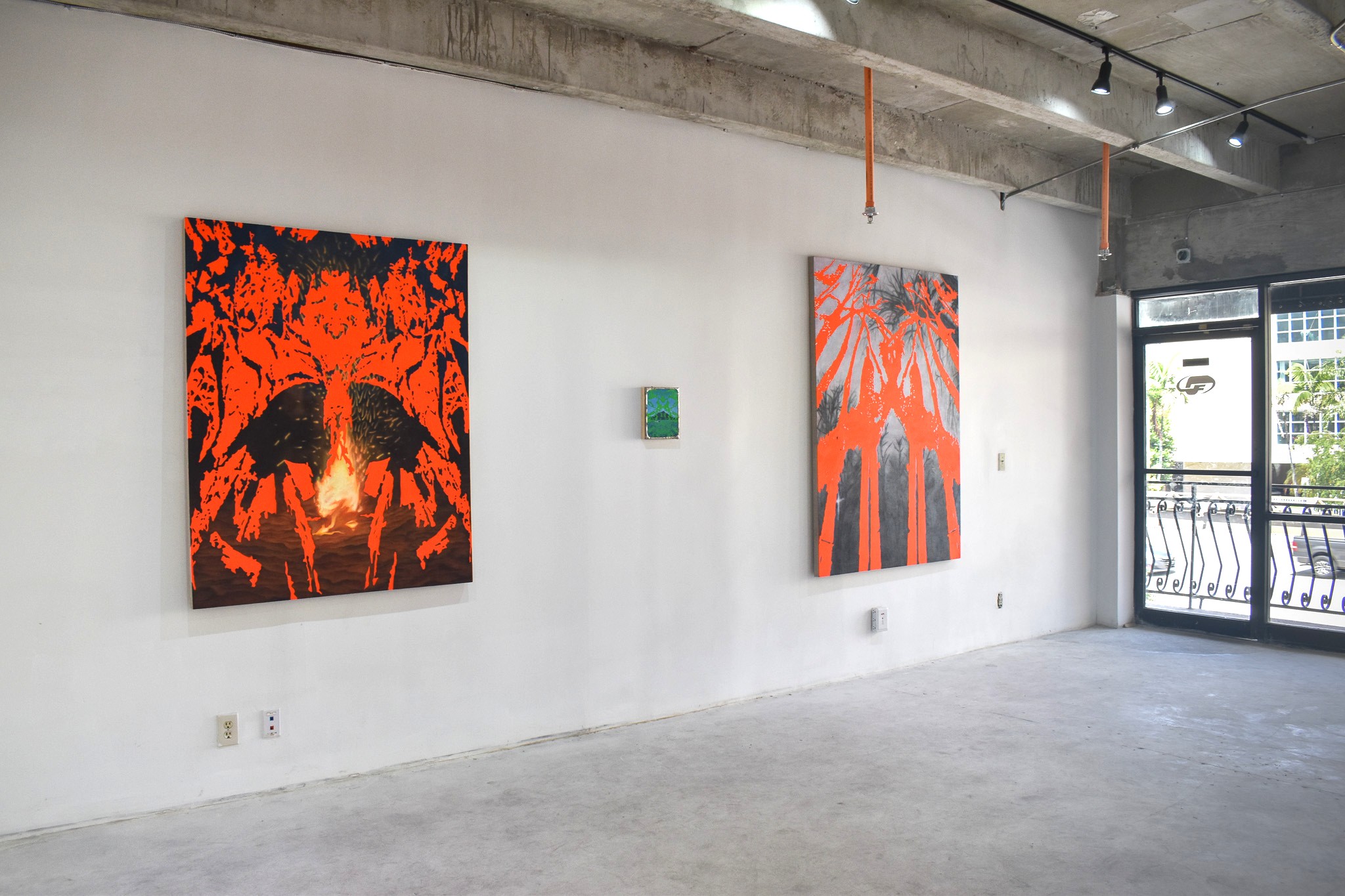
CA: Because your works embody this unique friction between realism and abstraction, I’m curious about some of your historical reference points. Which artists have inspired you?
AB: I love this question. Artists like Richard Estes and Audrey Flack are so ingrained in my mind when it comes to making work. Their technical skill is wild, and I’ve always admired that level of precision. Flack was a wizard with the airbrush, and I’ve always loved Estes’ landscapes and how he could capture so much detail by referencing his own photographs. John Baldessari has also been a strong influence in my practice, especially in the way he disrupted images through shapes and color. I think that combination of artists really connects to what I’m interested in, shifting the way we normally view/ interpret work.
CA: The amorphous abstract shapes or designs in your paintings are photos you took that have been digitally stretched and manipulated, while the realism in the background remains untouched. Are both of those photos rooted in the same memory? Or are they two separate moments that are related in some way?
AB: It depends on the piece, but not always. Usually, they come from separate moments but are connected through the same memory or concept. Other times, both images derive from the same existing memory. I make so many digital renditions of each piece before I’m happy with the final result. My desktop is honestly a nightmare when I’m making new work because I’ll grab photos from my camera roll and see what works and what doesn’t. It’s such a trial-and-error process when working on just one piece.

CA: Some of your pieces, such as At Home, 2025 and In Too Deep, 2026, incorporate materials such as solder wire and sea glass. Do you choose these materials for their personal associations, their physical qualities, or some combination of the two? How do you determine when a piece calls for materials beyond paint?
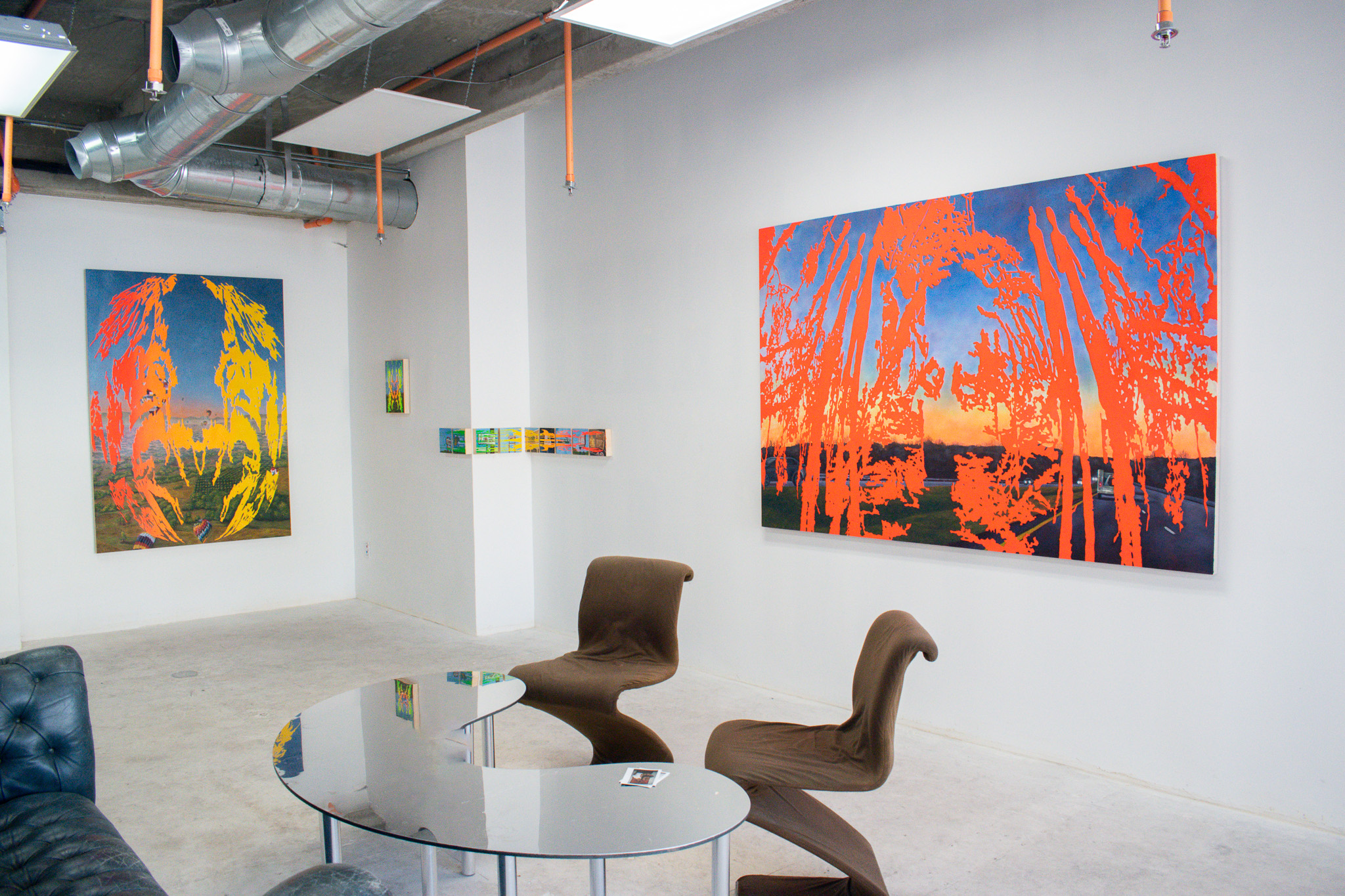
AB: I wanted to find a material that could mimic the effect of fluorescent paint, something reflective and almost the opposite of paint, but still feel permanent. I also naturally hoard little rocks and objects that I find, whether it’s family memorabilia or sea glass from a beach day, so incorporating these objects into my work felt really natural. They almost become like little time capsules within the paintings. I’ve always been obsessed with the idea of time capsules, probably because I saw that one episode of Zoey 101 when I was younger. The smaller works especially give me more room to play and take away some of the pressure and commitment that comes with making a larger work. That’s part of what makes them so special to me.
CA: You begin each painting with an abstract layer before introducing the photographs associated with memory. I first noticed this through the color bleeding onto the sides and the subtle pops of color throughout the painting. Was there something about working through the abstraction first that felt more instinctive than using a stencil or another predetermined method?
AB: Yes, definitely. Starting with the abstraction feels much more intuitive to me because I can alter the form as I go and make changes as needed. Painting the oil around the abstract form also makes my practice feel more meditative and allows me to reflect as I create. That order of working is also more forgiving. Using a stencil or screen print would be much more predetermined. I like getting right into the work and letting the painting develop through that back-and-forth between instinct and intention.
CA: You speak a lot about your works acting somewhat as nostalgic homages to specific landscapes or memories. How much do you consider the future in your practice?
AB: My practice offers so many avenues for me to continue exploring digitally. The images I’ve used so far have been very location-specific, leaning toward the notion of memory. I don’t necessarily know what the future holds for my practice, but that uncertainty is what excites me. I definitely see myself incorporating more materials like solder into my paintings, and I’m really looking forward to seeing where that takes me.
Cristina Ameller is an artist and musician based in Miami, Florida. Active within South Florida’s music scene, she performs as a drummer with several local bands while also working closely with QUEUE Gallery x Q Magazine as a curatorial and editorial assistant. Her multidisciplinary practice moves between visual culture and music, often centering communication and community engagement.
